

TL;DR:
- Modern all-inclusive landing page plans bundle tools, hosting, SSL, and support into a single predictable fee.
- These plans typically cost $29 to $249 monthly, with higher tiers offering advanced features like A/B testing.
- Simplified, bundled plans are preferred by SMBs for operational efficiency and faster campaign deployment.
Business owners shopping for landing pages often brace for a long list of add-on charges. Hosting billed separately. SSL certificates extra. Support locked behind a premium tier. The reality in 2026 is different. Most modern landing page platforms now bundle everything into a single, predictable fee. This guide breaks down what all-inclusive pricing actually covers, what real plans cost, where the fine print hides, and how to choose the right option for your business without second-guessing every line item.
Table of Contents
- What does all-inclusive landing page pricing mean?
- Typical cost structures and what's included
- Key mechanics and hidden nuances in pricing
- All-inclusive vs. a la carte: Which is right for your business?
- How to evaluate and choose the best plan
- Why smart SMBs are shifting to all-inclusive landing page pricing
- Launch smarter with an all-inclusive landing page solution
- Frequently asked questions
Key Takeaways
| Point | Details |
|---|---|
| Flat rate covers essentials | Modern all-inclusive landing page plans include hosting, support, templates, and more for one predictable monthly fee. |
| Tiered pricing with limits | Plans often have visitor or feature caps, so check for possible overages or required upgrades. |
| Comparison beats guesswork | Reviewing real plan costs and features lets you pick the best value for your business size and goals. |
| Simplicity saves time | SMBs benefit most from bundled solutions designed to avoid 'duct-taped' tech stacks and hidden costs. |
What does all-inclusive landing page pricing mean?
The term gets used loosely, so it helps to pin down a clear definition. All-inclusive landing page pricing refers to subscription plans that bundle creation tools, unlimited pages, hosting, SSL, templates, basic support, and often A/B testing or integrations into a single monthly fee, without separate charges for core usage.
In plain terms: you pay one fee, and the tools you need are already included. No per-page charges. No separate hosting invoice. No surprise SSL renewal bill at the end of the year.
Here is what a solid all-inclusive plan typically covers:
- Drag-and-drop page editor with no coding required
- Unlimited landing pages under one subscription
- Free hosting on a managed server
- SSL certificate for secure connections
- Pre-built templates across industries
- Basic customer support via chat or email
- Third-party integrations such as email platforms and CRMs
- A/B testing tools (usually on mid-tier plans and above)
This model became popular with small and medium-sized businesses for one core reason: predictability. When your marketing budget is tight, surprise invoices are a real problem. A flat annual or monthly fee removes that uncertainty.
"All-inclusive pricing lets small business owners focus on running campaigns, not managing a patchwork of tools with separate billing cycles."
Fragmented tech stacks are a hidden time drain. When hosting, analytics, and the page builder each send a separate invoice and require separate logins, the overhead adds up fast. Bundled plans remove that friction. You can explore custom landing page features to see how a fully managed setup compares to self-assembled solutions.
Typical cost structures and what's included
Now that you know what the bundle covers, it helps to see what real plans actually cost. Entry-level SMB plans typically run $29 to $99 per month, with advanced tiers reaching $149 to $249 per month for features like A/B testing, higher traffic allowances, and priority support.

Here is a snapshot of how leading platforms compare:
| Platform | Entry price (monthly) | Visitor cap | Key inclusions |
|---|---|---|---|
| Leadpages | $37 (annual) | Unlimited | Templates, hosting, SSL, integrations |
| Unbounce | $99 | 20,000 visits | A/B testing, AI tools, custom domains |
| Instapage | $79 (annual) | 30,000 visits | Collaboration tools, analytics, integrations |
| Landingi | $29 | 5,000 visits | 300+ templates, basic analytics, SSL |
Most platforms offer annual billing that saves you 15 to 25 percent compared to month-to-month rates. That discount alone can cover several months of service over a full year. Understanding how landing page pricing works across different providers helps you benchmark offers before committing.
Also worth noting: entry-level plans often limit the number of custom domains or connected integrations. Mid-tier plans unlock more of both. Enterprise plans typically require a direct quote rather than a published price.
Pro Tip: Use free trials before paying. Most top providers offer 14-day trials with full feature access. Test your actual workflow, not just the demo, before choosing a plan.
Key mechanics and hidden nuances in pricing
The sticker price is only part of the story. The fine print is where costs can shift unexpectedly. Tiered subscription models are standard across the industry, with three to four tiers common, monthly or annual billing, and visitor or conversion caps on lower tiers that trigger upgrades when exceeded.
Here are the most common areas where business owners get surprised:
- Visitor or conversion caps: Many entry plans cap monthly unique visitors at 5,000 to 20,000. Exceed that and you either upgrade or lose traffic.
- Transaction fees: Some lower-tier plans charge a percentage fee on sales processed through the page.
- Custom domain limits: Entry plans may allow only one or two custom domains.
- Advanced tool restrictions: A/B testing, heatmaps, and AI features are often locked to higher tiers.
- Team member seats: Adding a second user sometimes requires a plan upgrade.
The word "unlimited" deserves scrutiny. Some platforms advertise unlimited pages but cap monthly traffic. Others offer unlimited traffic but limit the number of active campaigns. True unlimited plans, with no caps anywhere, are usually enterprise-level and require negotiated pricing rather than a published rate.
| Scenario | Truly unlimited? | Watch for |
|---|---|---|
| Page count | Usually yes | Active campaign limits |
| Monthly visitors | Often capped | Overage fees or throttling |
| Custom domains | Usually capped | Per-domain add-on fees |
| A/B tests | Mid-tier and up | Test count limits |
| Team seats | Usually capped | Per-seat upgrade costs |
Pro Tip: Before signing up, ask the provider directly: "What happens when I exceed my visitor limit?" The answer tells you a lot about how they handle growth.
Reviewing SMB landing page plans side by side helps surface these differences before they become a problem.
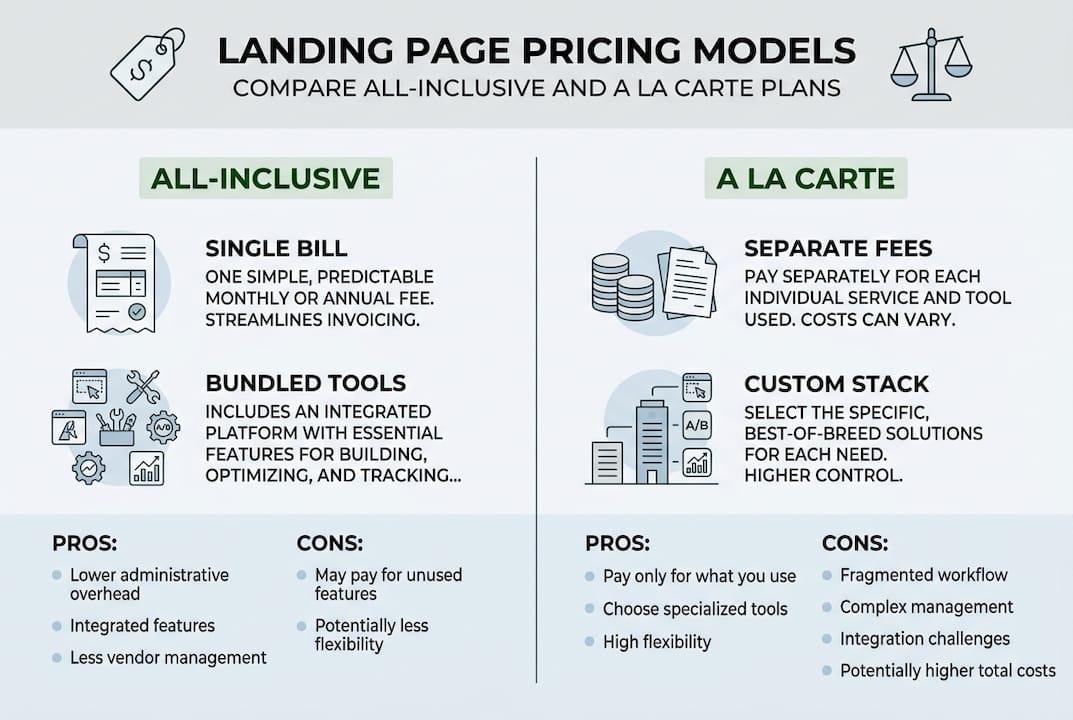
All-inclusive vs. a la carte: Which is right for your business?
Some businesses prefer to build their own stack. They pick a page builder, add separate hosting, connect an analytics tool, and manage each piece independently. This a la carte approach offers maximum control. It also requires more time, more technical knowledge, and more billing management.
All-inclusive plans are preferred for simplicity, especially for SMBs that want to avoid duct-taping tools together. Premium platforms like Unbounce and Instapage at $99 and above suit businesses focused on conversion rate optimization. Budget options like Leadpages at $49 cover the basics well.
All-inclusive works best when:
- Your team is small and speed matters more than customization
- You want one vendor, one invoice, and one support contact
- You are running time-sensitive campaigns and cannot afford technical delays
- Your budget is fixed and predictability is a priority
A la carte works better when:
- You already have hosting and only need a page builder
- You have a developer on staff who can manage integrations
- Your traffic volume is high enough that per-seat or per-feature costs favor custom assembly
"Most small businesses underestimate the hidden cost of managing multiple tools. The time spent troubleshooting integrations is time not spent on marketing."
The value of bundled plans is not just financial. It is operational. Fewer logins, fewer vendor relationships, and fewer points of failure. You can compare business landing page options to see how bundled and custom approaches differ in practice. For most SMBs, the simplicity of all-inclusive wins. For power users with specific technical needs, Unbounce plan benefits at the higher tier may justify the extra cost.
How to evaluate and choose the best plan
Choosing a plan is easier when you follow a structured process. Here is a practical roadmap:
- Estimate your monthly traffic: Know your current and projected visitor numbers before looking at any plan. This determines which tier you actually need.
- List your required integrations: Check that your CRM, email platform, and payment processor connect natively, not just through a workaround.
- Confirm support access: Find out if support is chat, email, or phone, and what the average response time is.
- Calculate annual vs. monthly cost: Annual plans save 15 to 25 percent compared to monthly billing. Run the math before defaulting to monthly.
- Start with a free trial: Most providers offer 14-day trials. Use the trial to test your actual campaign workflow, not just the template library.
- Read the visitor cap terms: Ask specifically what happens when you exceed the cap. Some platforms throttle traffic; others charge overages.
- Check contract terms: Month-to-month plans offer flexibility. Annual plans save money but lock you in. Know which matters more for your situation.
A good starting point for most SMBs is a $49 per month plan with hosting and support included. Scale to the $99 to $229 range only when A/B testing or higher traffic limits become a real need. Reviewing pricing page strategies used by top SaaS platforms can also help you spot what a well-structured offer looks like versus one designed to obscure costs.
You can also review a landing page recommendation tailored to SMB needs to see how a fully managed plan compares on value.
Why smart SMBs are shifting to all-inclusive landing page pricing
The shift toward bundled pricing is not just a pricing trend. It reflects a broader change in how small businesses think about their marketing operations. Piecemeal setups used to feel like smart cost control. In practice, they created fragile systems that broke at the worst moments, usually right before a campaign launch.
Today's most effective small businesses prioritize speed and reliability over maximum flexibility. A flat, bundled plan means a new campaign can go live in days, not weeks. There are no integration issues to debug and no billing surprises to explain to a finance team.
The businesses that have made this switch report one consistent benefit: less time managing tools and more time running campaigns. That is not a minor operational detail. It is a competitive advantage. Our landing page insights reflect the same pattern: businesses that simplify their stack move faster and waste less budget on overhead.
Launch smarter with an all-inclusive landing page solution
If you have been spending time comparing pricing tiers, reading fine print, and worrying about overage fees, there is a simpler path. Landing Page Studios offers a fully managed, all-inclusive landing page service at $199.99 per year. That covers custom design, hosting on Cloudflare's global network, ongoing updates, and technical support.
There are no visitor caps, no surprise invoices, and no technical setup required on your end. Pages are delivered in two days, built with clean code for fast load times, and fully mobile responsive. If you are ready to stop managing tools and start running campaigns, start with Landing Page Studios to see exactly what is included.
Frequently asked questions
What does 'all-inclusive' really include in landing page plans?
All-inclusive plans typically cover unlimited pages, hosting, SSL, templates, support, and often A/B testing for one flat fee, with no separate charges for core tools.
Do all-inclusive plans have extra or hidden fees?
Some plans charge overage or transaction fees when you exceed visitor limits or use premium features. Always check the fine print before committing, since visitor limits trigger overages on many entry-level plans.
Is it better to choose all-inclusive or pay-as-you-go pricing?
All-inclusive is preferred for SMBs that value simplicity and predictable costs, while a la carte plans may suit power users who need custom configurations and already have parts of the stack in place.
What's a typical entry-level price for all-inclusive landing pages?
Most entry-level plans cost $29 to $99 per month, with annual billing discounts of 15 to 25 percent making the yearly commitment the better financial choice for most businesses.